


How to Make Smart Moves Without Waiting for a Fed Miracle (1980–2026 Mortgage Rates, Home Prices, Policy, and Buyer Decisions)
Do you remember when a 10.1% mortgage rate in 1990 felt like a fair deal? Or back in April 1980, when rates skyrocketed past 16%? By the turn of the millennium, buyers were looking at 8%, and just two decades later, we witnessed historic sub-3% lows. Was that ultra-low era a new baseline or a historical anomaly—and could we ever see it again? Below, we break down what drove this dramatic shift—and how to align your expectations for the future of interest rates.
Key Takeaways
- Anchoring to Recent Memory: A large share of today’s buyers (and the broader public) experienced or closely observed the 2020–2021 period of 3% and sub-3% rates. That era became the mental benchmark. Anything above it feels expensive, even if 6% is closer to longer-term historical norms than the ultra-low period was.
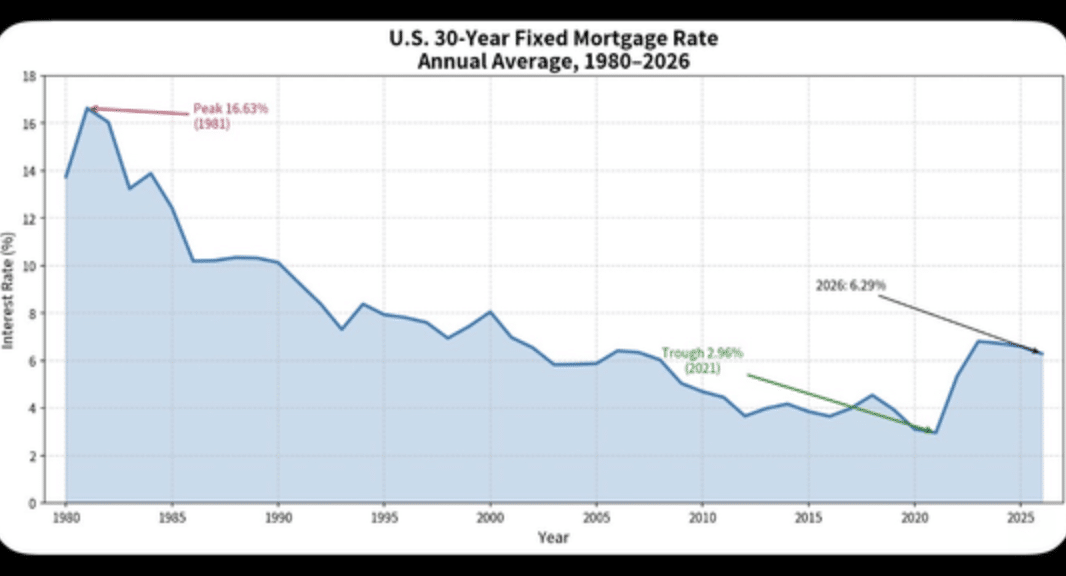
- Multi-Decade Mortgage Rate Trajectory: Between 1980 and 2026 the U.S. 30 year fixed mortgage rates underwent a long-term structural decline from a peak near 16.6% in 1981 down to historic lows (~3%) in 2020–2021, before stabilizing in the mid-6% range by 2026.
- The Role of Quantitative Easing: The ultra-low rate environment (sub-4% and sub-3%) required unprecedented Federal Reserve intervention (Quantitative Easing), meaning these rates were policy-driven anomalies rather than the historical baseline.
- Market Realignment: History shows that rate cuts are quickly followed by home price increases. The sweet spot—where buyers enjoy lower interest rates before home prices adjust upward—is very brief and often missed.
- The Tailwinds of Housing Appreciation: Falling borrowing costs over four decades served as a primary engine for national home price growth, amplifying gains beyond what wage growth, demographics, and supply alone would have driven.
- Reframing Ownership (Shelter vs. Investment): Waiting indefinitely for 3% rates is an unreliable strategy; buyers are better served prioritizing housing as a practical need for long-term stability and community rather than treating primary residences solely as speculative wealth vehicles.
The Four-Decade Evolution of U.S. Mortgage Rates
From 1980 to 2026 the U.S. 30 year fixed mortgage rates followed a long-term downward path. Rates peaked near 16.6% in 1981 during the high-inflation Volcker era, then declined over subsequent decades to historic lows around 3% (and briefly under 3%) in 2020–2021 before rising to the mid-6% range by mid-2026. While not a straight line—cyclical increases occurred—the multi-decade trend was one of structural decline driven by disinflation, monetary policy evolution, and other macroeconomic forces. Critically, sustained annual averages below 5% were rare before 2008; the lowest pre-crisis readings were typically in the mid-to-high 5% range. The first multi-year stretch of sub-5% rates (and especially the ultra-low sub-4% and sub-3% periods) occurred amid or after large-scale Federal Reserve interventions.
How Falling Rates Fueled Home Price Growth
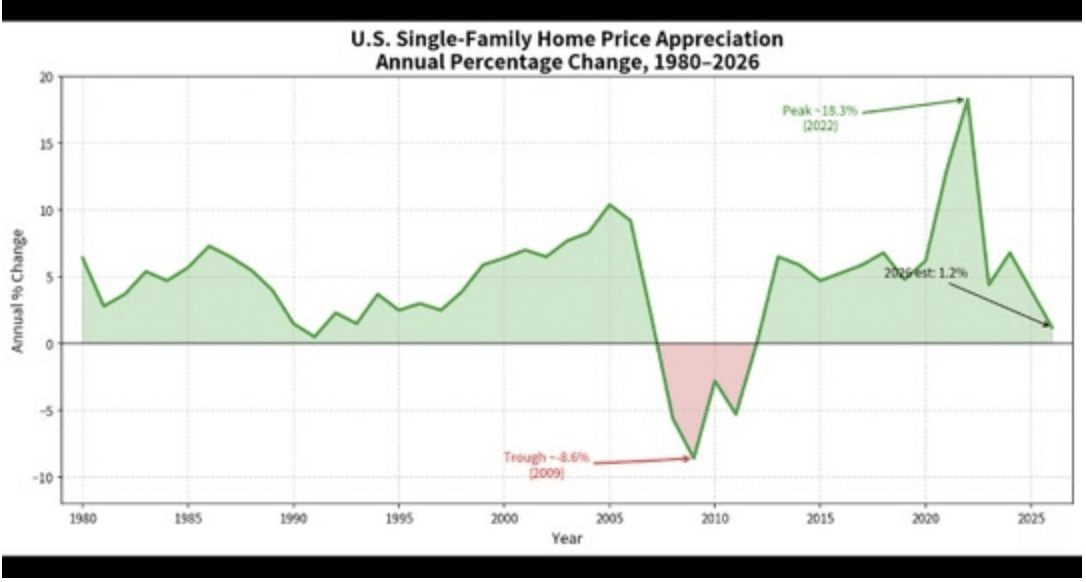
National single-family home prices generally appreciated over the same span, with annual percentage gains positive in most years. Stronger advances often coincided with periods of declining or low rates, which expanded buyer purchasing power and supported demand. Declines were concentrated in the 2008–2011 housing crisis. The secular drop in rates acted as a powerful tailwind, amplifying price growth beyond what supply, demographics, and incomes alone might have produced.
Federal Reserve Intervention and Quantitative Easing (QE) Era
Quantitative easing (QE) is an unusual tool used by a country’s central bank to boost the economy, increase the money supply, and lower long-term borrowing costs. It happens when regular interest rates are already near zero and the economy needs extra help (2008 recession is an example).
Government intervention played a material role in the lowest-rate periods. The Federal Reserve conducted large-scale asset purchases (quantitative easing, or QE)—buying longer-term Treasuries and agency mortgage-backed securities—to compress yields when the policy rate was near zero. These programs operated for roughly 10 calendar years, primarily 2008–2014 (post-financial crisis) and 2020–early 2022 (COVID response). Routine open-market operations existed earlier, but the extraordinary, large-scale bond-buying aimed at lowering longer-term rates was concentrated in those crisis-response windows. After QE3 ended in 2014, rates remained below 5% for several years (notably 2015–2019) without new large-scale purchases, but the deepest lows required active QE.
The New Economic Landscape: What to Expect Moving Forward
Three core themes emerge. First, the economy operated in a long-term rate-lowering environment from 1980 to 2026. Second, national home-price appreciation benefited from that tailwind of cheaper borrowing costs. Third, QE programs artificially supported and extended the lowest rate periods. Looking forward from 2026, with rates near 6% and without ongoing extraordinary accommodation, the same powerful rate-decline tailwind is unlikely to repeat. Expert forecasts for a higher-for-longer rate environment generally point to more modest nominal home-price growth—often low single digits annually, in some projections roughly in line with inflation—rather than the stronger gains of the prior low-rate decade. Future appreciation will depend more on fundamentals: housing supply, household formation, incomes, local inventory, and conventional policy.
Geographic Realignment: The Search for Affordable Markets
If rates remain near 6%, affordability pressures in expensive coastal metros, big cities, and popular resort towns intensify. This supports continued migration toward lower-cost markets, encouraging growth and some sprawl in receiving areas. Data from 2024–2026 show ongoing net outflows from high-cost regions (e.g., parts of California and the Northeast) and inflows to more affordable destinations. Markets frequently cited as relatively accessible for first-time buyers or relocating house hunters include Palm Bay, Tampa, Orlando, Jacksonville, and the North Port/Sarasota area in Florida; Surprise, Gilbert, Chandler, Peoria, and Yuma in Arizona; Boise, Idaho; Murfreesboro, Tennessee; San Antonio and Houston, Texas; Birmingham, Alabama; Raleigh, North Carolina; Atlanta, Georgia; and select Midwest cities such as Detroit, St. Louis, Louisville, and Fort Wayne. These places combine comparatively lower prices, available inventory or new construction, and lifestyle appeal, though local conditions (insurance, jobs, specific neighborhoods) still vary.
The Psychology of Buyer Hesitation and Market Anchoring
Despite the historical record showing that sustained rates well below 5% required unusual policy support, many potential buyers continue waiting. They often anchor on the recent memory of 3% rates, hope for further Fed cuts or price softening, face limited inventory of desirable homes, and respond to payment shock in high-price markets. A 1% rate decline improves buying power only modestly (roughly 10–12%) and frequently fails to restore comfortable affordability in coastal or resort areas. Public understanding of the longer rate history and the exceptional nature of the post-2008 ultra-low period is generally limited; most people react more to recent experience and short-term headlines than to multi-decade trends.
Buy or Rent? A Practical Decision Framework
A practical decision framework for those considering purchase in the more affordable markets is as follows. Buying now locks in a fixed payment and ownership. If rates later decline, the owner can benefit from any resulting price support and potentially refinance. If rates stay elevated or rise, the buyer already holds a fixed-rate mortgage and has secured housing rather than remaining exposed to rent increases. Continuing to rent preserves flexibility and avoids ownership costs, but forgoes equity buildup and leaves the household subject to landlord rent hikes in any cycle. Price appreciation may slow nationally, yet ownership still builds wealth through principal paydown.
Rethinking Homeownership: Shelter vs. Investment
Finally, the discussion underscored a values-based distinction. People need shelter. Treating a primary residence primarily as an investment vehicle can distort decisions. For pure financial returns, renting inexpensively and investing surplus savings in diversified stocks has often been the stronger pure-investment approach. At the same time, homeownership supplies non-financial benefits—residential stability, control, community ties, and a sense of rootedness that many families value—that cheap renting typically does not fully replicate. In an environment of rates near 6% and more modest expected appreciation, the rational approach for many is to buy for shelter and stability in a market they can afford, rather than stretching for an investment thesis dependent on a return of extraordinary low rates. The community and family dimensions remain legitimate reasons to prefer ownership even when the pure investment case is less compelling than in the prior era.
Conclusion: Making Informed Decisions in a Normalized Market
In aggregate, the 1980–2026 record shows a long rate decline that supported home-price gains, with QE helping produce the lowest rates. That specific tailwind has largely run its course. Buyers who understand the history, prioritize sustainable shelter in accessible markets, and weigh both financial and non-financial returns are better positioned than those waiting indefinitely for a return of conditions that required unusual policy intervention.
Sources:
Google Gemini, Grok and all associated links, www.themortgagereports.com, www.amerisave.com