


In the world of investing, headline data often provokes immediate emotional reactions. Yet, enduring wealth creation relies not on reacting to shifting short-term indicators, but on understanding the broader structural context of economic indicators, historical market cycles, and human behavior. As we evaluate the current mid-2026 economic landscape against historical benchmarks, several clear themes emerge regarding macroeconomic stability, market resilience, and the eternal tug-of-war between emotional impulses and sound investment strategy.
We Have A Plan!
Below, we cover four key topics, all of which reflect time-tested principles. The core of our investment strategy is based on a landmark 1952 paper written by Harry Markowitz at the University of Chicago titled Modern Portfolio Theory (MPT)—work for which he was awarded the Nobel Prize in Economics in 1990. Harry later lived in San Diego, taught as a professor at UCSD, and left behind an enduring legacy before passing away in 2023 at the age of 95.
Troy had the opportunity to meet Harry in 2000 and invited him to speak at a San Diego Financial Planning Association (FPA) chapter meeting. Their in-depth discussion about his thesis provided key insights into the asset allocation strategies we continue to use at our firm today.
Having studied MPT in college, I was delighted to join a firm built so squarely on his foundational principles. Our mission remains simple: preserve legacies, grow assets, and always put your interests first.
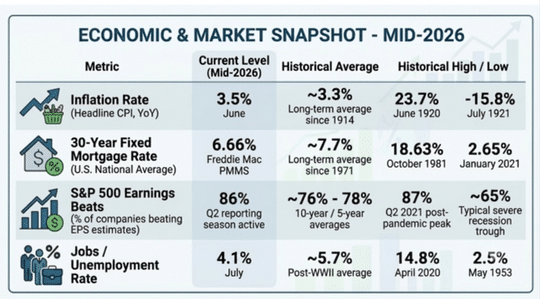
1. The Current Economic & Market Snapshot
Evaluating current macroeconomic metrics against historical norms provides essential grounding. While headlines frequently highlight volatility, a structured review demonstrates that current economic fundamentals remain remarkably robust relative to long-term cycles. We review these indicators monthly to guide asset allocation decisions centered on MPT.

2. Asymmetry of Bull and Bear Markets
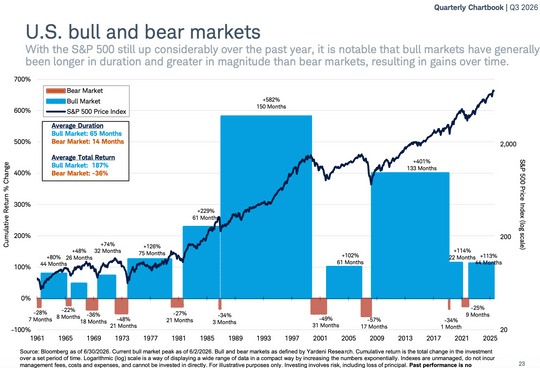
A frequent error among investors is overestimating the destructive capacity of bear markets while underappreciating the compounding power of bull markets. Historical data spanning decades reveals a stark asymmetry: bull markets are vastly longer in duration and greater in magnitude than bear markets.
On average, historical S&P 500 bull markets endure for roughly 63 months, delivering an average cumulative return of 181%. In contrast, bear markets are comparatively brief, averaging 14 months with a 36% average drawdown. Long-term wealth can be built by staying anchored to diversified portfolios through the short-term storms.

3. The Emotional Investment Cycle vs. The Hype Cycle
While markets trend upward over decades, individual investor behavior rarely follows a straight line. Psychological models mapping the Emotional Investment Cycle and the Hype Cycle demonstrate how human emotion distorts financial decision-making.
Key Behavioral Insight: Market peaks are characterized by Euphoria (“We are all going to be rich!”) and maximum risk exposure, whereas market troughs induce Panic, Anger, and Depression (“I lost everything…”). Ironically, the point of maximum financial pessimism may represent the point of maximum long-term opportunity.
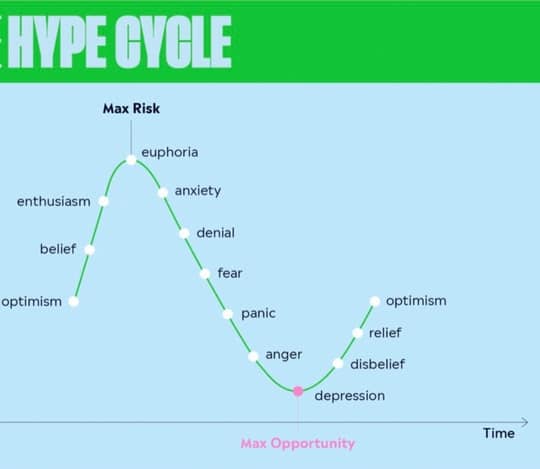
When investors permit fear or euphoria to dictate strategy, they risk buying near the top during phases of thrill and belief, and capitulating at the bottom during panic. Recognizing these emotional phases allows disciplined investors to counter instinctual impulses, avoiding reactionary selling and positioning themselves to capture subsequent recoveries. Implementing Modern Portfolio Theory (MPT) helps smooth out portfolio volatility, mitigating the impact of these market extremes.
4. Politics Versus Sound Investment Principles
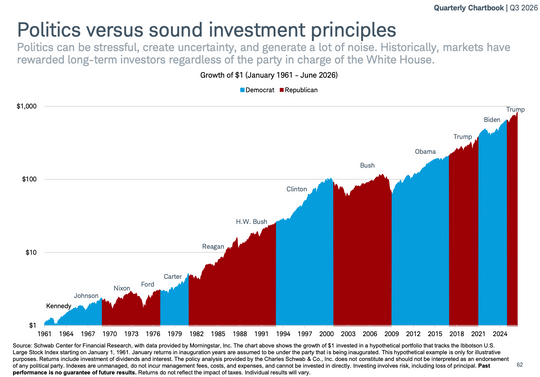
Another perennial distraction for market participants is electoral politics. Media commentary frequently stokes anxiety over which political party occupies the White House, suggesting that a shift in the presidential administration, the House, or the Senate will permanently derail portfolios.
However, long-term historical charts tracking the growth of $1 across successive Republican and Democratic administrations—prove that markets reward long-term investors regardless of the political party in power. Corporate earnings, technological innovation, and American productivity ultimately drive market valuations far more effectively than Washington policy shifts. Attempting to time the market based on election outcomes is a proven strategy for underperformance.

Conclusion
Successful long-term investing requires filtering out transient noise. Supported by strong corporate earnings, stable employment, and normalizing inflation, current market conditions reiterate a timeless truth: MPT, discipline, patience, and adherence to a well-crafted financial plan remain the potential true drivers of long-term wealth creation. Our team continues to monitor the economy, just as we always have, to make informed decisions about your accounts.